
Office Reform Starting with the General Affairs Department. What is Layout Improvement that Moves the Organization?
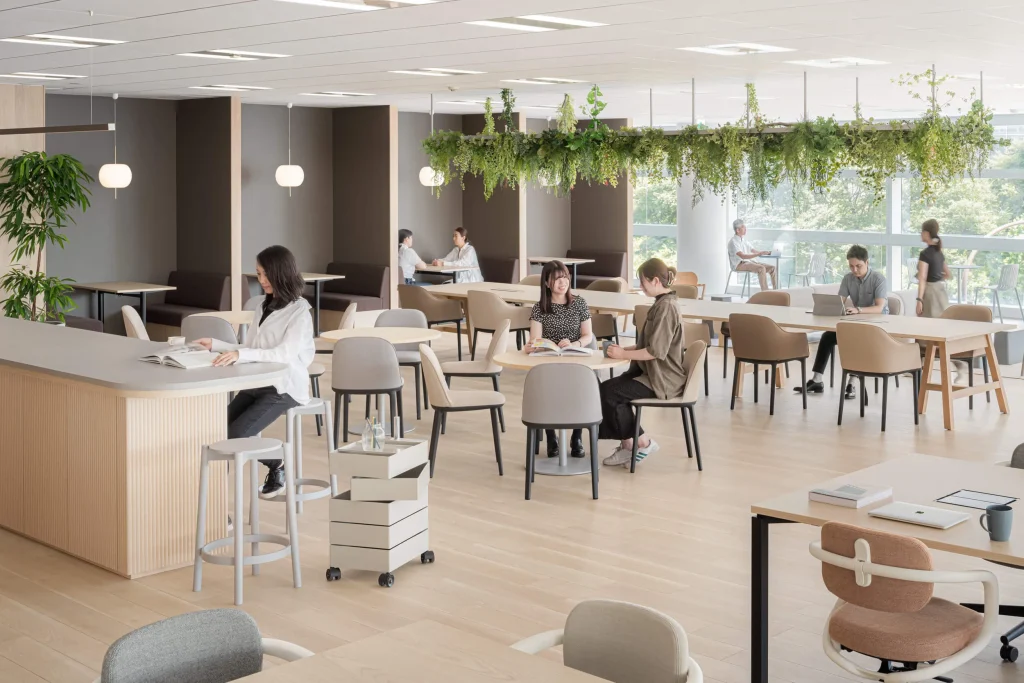
As remote work has become more prevalent while opportunities to come to the office have increased, the general affairs department has been receiving many concerns about the changes in work styles.
The conference room looks empty, but when I try to reserve it, it’s already full.”
“People are coming back to the office, but I don’t feel connected across departments.”
“There is no place to chat, and it’s hard to find opportunities for communication.”
These voices are commonly heard in many companies.
At first glance, they may seem like minor inconveniences in daily life, but when they accumulate, they can affect work efficiency and human relations.
Now that people can flexibly choose where to work, the role of the office is shifting from “a place to work” to “a place that encourages collaboration and fosters relationships.
Despite this, when they do come to work, they spend the majority of their time working silently at their monitors, making it difficult to generate conversations and incidental communication across departments.
Many offices are still in such a state.
As this environment continues, office usage itself becomes fixed, and the following obstacles begin to surface in day-to-day operations.
There are meeting rooms that are actually available, but they are booked up and can’t be gathered quickly.”
“Employees don’t know each other what kind of people are in the company.”
“Only the minimum amount of conversation is generated, and the organization becomes rigid.”
and the business opportunities that could have been created by a little consultation or an accidental encounter are undermined.
So how should we find solutions to these challenges?
This article introduces the concept and specific steps to be taken when General Affairs takes the lead in improving the layout, organized in an easy-to-understand manner.
目次
- 1 The key to solution is not “furniture arrangement” but “human movement” design.
- 2 Challenges that general managers are likely to face when promoting layout improvements
- 3 Image of office operations as seen at Interoffice’s Tokyo headquarters
- 4 Steps for Layout Improvement Led by General Affairs
- 5 Summary: Small steps move the organization forward.
The key to solution is not “furniture arrangement” but “human movement” design.
So, what specific perspectives should be taken into account in making improvements? Common to many examples of failure is the tendency to think in terms of furniture, such as “filling the office with uniform seating to maximize the number of seats” or “creating a refreshment area in the corner of the office.
Layout improvement is not just about arranging furniture.
- Where can we focus?
- Which flow line would be easier to call on?
- Which arrangement would create a chance encounter?
Thus, facing the behavior of workers and intentionally setting up the environment and flow lines is the essence of layout improvement.
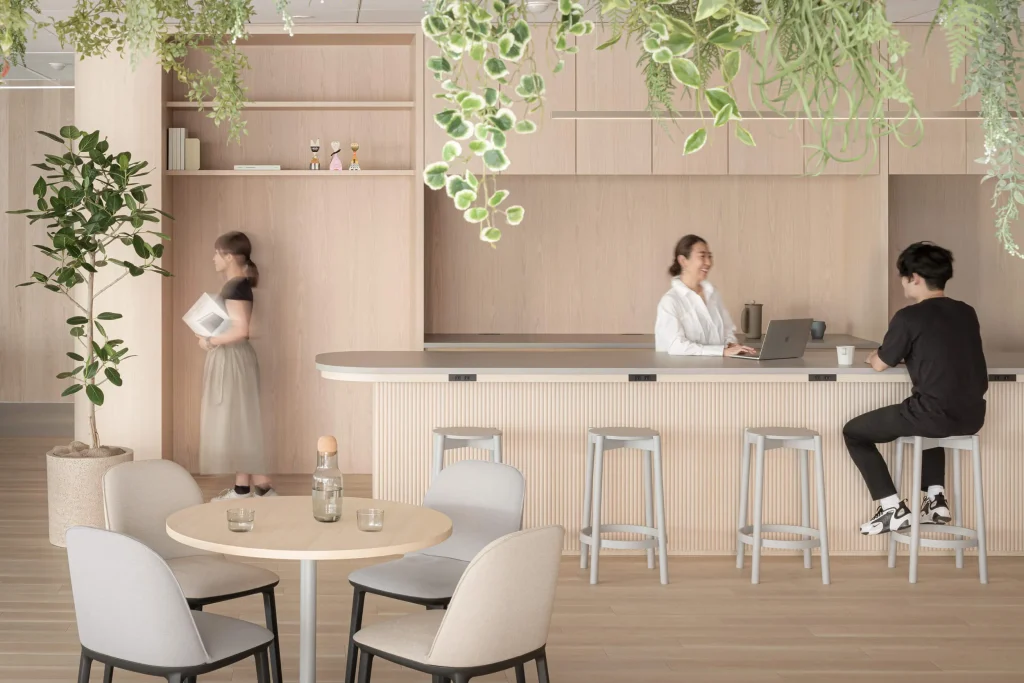
For example, simply arranging shared spaces along flow lines naturally encourages cross-departmental conversations. Conversely, in areas where intensive work is required, it is essential to control line of sight and sound. It is necessary to consider the layout based on the type of environment to be created, rather than on the type of furniture to be placed.
The general affairs department is responsible for this overall planning.
The key is the ability to decipher the “real issues” from the voices of the field. Simply planning a social gathering is not the root solution to the common problem of “not knowing what the department next to you is doing.
Rather, proposals are required that bring about a positive impact of the space on the way people work, such as “designing a layout where the main lines of flow dare to intersect so that they naturally meet each other. We need to move both parties along by communicating to management that this will lead to a revitalization of the organization, and to the work site that it will improve the usability of the space.
There will also be more mundane tasks such as coordinating and securing budgets. However, the organization will certainly change if the general affairs department takes the lead in such “tricks. In the next chapter, we will discuss the points to overcome such “barriers” while organizing them.
Challenges that general managers are likely to face when promoting layout improvements
Many companies face a common challenge in the planning stage when attempting to improve their internal layout.
What are some of the ways in which general administration efforts can stumble?
Issue 1: Difficult to see the true nature of the inconvenience
Employees sometimes say
“For some reason, the meeting room I thought was occupied is empty.”
“There is an atmosphere in the company where it is somehow difficult to talk to someone.”
However, if this “casual inconvenience” is left as it is, it will not lead to improvement.
The true nature of the problem will become clear only when the actual situation is visualized as data, such as the usage of meeting rooms and seats, where people tend to gather, which flow lines are active and which are quiet, and so on.
The first hurdle tends to be getting the facts together, rather than just a feeling or impression.
Issue 2: How to organize internal opinions
The reality is that the field demands improved functionality, saying, “I want it to be easier to use,” while management emphasizes return on investment, so the discussion tends to parallel the lines.
Other calls for “more concentration booths” and “more meeting space” at the same time make it difficult to determine priorities.
The general manager needs to understand the background of both sides’ opinions, and to construct a realistic compromise.
This is truly a situation where your competence as a “coordination specialist” is tested.
Challenge 3: How to balance cost and speed
It is not surprising that many companies are unable to take the plunge right away, as a complete office renovation would require a great deal of time and money.
So, do we have no choice but to put off improving the layout?
–the answer is no.
In recent years, there has been an increase in “small trial” improvement methods, such as furniture subscriptions.
- First, try changing just one floor.
- Review only the flow line.
- Place one high table
If the approach is a partial one, such as “We will be able to proceed with a sense of speed while confirming the response on site.
Small successes will make it easier to obtain agreement from employees.
These are common challenges that many companies face when working to improve their layouts.
So, what are the people who are actually responsible for the operation trying to do?
In the next chapter, we will hear from Interoffice’s general manager, who manages the office site, about the realities of the situation.
Image of office operations as seen at Interoffice’s Tokyo headquarters
Interoffice’s Tokyo headquarters operates as a “live showroom” where clients can see how employees actually work. When the office moved to the new location in 2017, it had free-address seating with a uniform layout of large tables, but now, with an emphasis on the “original free-address feel,” it is configured with a variety of furniture options, including high tables and sofa seating, so that employees can choose their working environment.
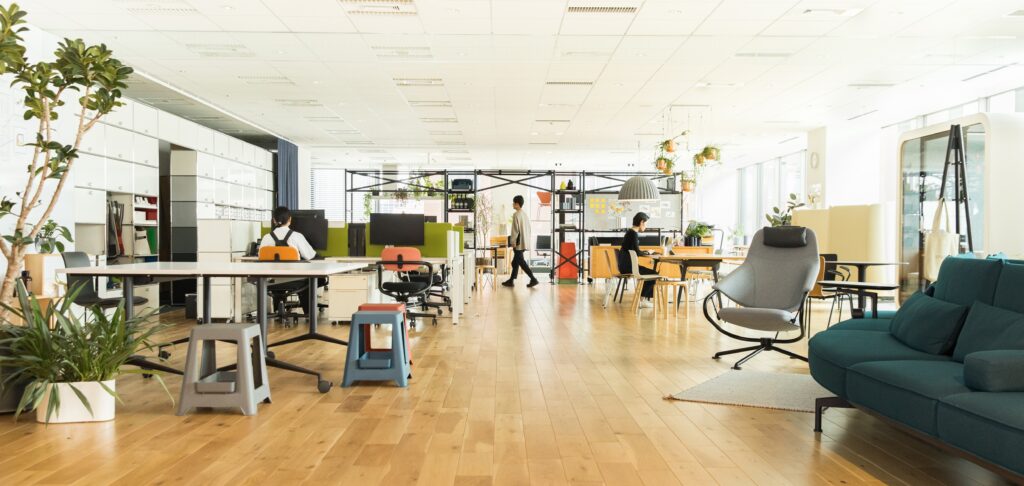
At first glance, it appears to be an ideal “office where you can choose the environment according to your work style,” but behind the scenes, there was a steady process of trial and error by the general affairs department and employees who supported the operation. The general affairs manager in charge of managing the site said, “We have been working on this project for several years now.
The ability to move furniture around and use it freely means that it will fall apart if left unattended. The challenge was that the spatial intent of the space could be compromised by forgotten chairs or equipment that was somehow left unattended.”
This is where communicating the intent of the layout and the culture of resetting became important.
1. verbalize and communicate the intention of “why this arrangement?
Simply saying, “Please work here” is not enough to get employees to move. If new employees do not fully understand the “intent of furniture arrangement,” such as “why there are tall tables here (to end meetings quickly by standing up)” and “why the aisles are wide here (to create accidental encounters),” they will use the furniture in a cluttered manner, and the place will become rough as a result. This can result in a cluttered environment. Conversely, if the general manager announces this “intention” properly at the time of hiring, the way employees use the space will change, and the function of the space will be maximized.
2. “Return after use” supports variability
Because the layout can be freely changed, it is essential to follow the rule of “returning the space to its original location (resetting) when finished using it. Interoffice requires a particularly high standard of aesthetics maintenance due to the showroom’s emphasis on appearance, and the same is true for general corporate offices. Defining and sharing a “default condition that the next user can use comfortably. This is the key to maintaining an office that is easy to use and pleasant to use.
Change is not the end. Continue to develop the “ability to use”.
Even if the layout is changed, if the mindset of the people working there does not change, it will eventually return to its original state. That is why Interoffice is currently working not only to install hardware (furniture), but also to strengthen our efforts to influence the software (people’s awareness).
Currently, we are considering introducing a “display styling course” to increase the spatial sensitivity of our employees. In addition to learning “techniques to make a space look beautiful and functional” from an outside instructor, the course also emphasizes the sharing of background (stories) such as “the intention of the layout and the difficulties of maintaining it” by those in charge of general affairs. By conveying both skills and background, the plan is to develop employees’ ability to use the office themselves.
Steps for Layout Improvement Led by General Affairs
Now that you have a clear picture of the operation, let’s look at the order in which you should actually proceed with layout improvement at your company. The key to success is not to suddenly change the entire layout, but to start “small” by following the steps below.
Step 1: Visualize the current situation
The first step is to understand how the current office is being used.
We are told that there is a shortage of meeting rooms, but we don’t know at what time of the day the shortage is actually occurring.
Unless we get the data, we will not know what is going on.
By recording behaviors that are not normally visualized, such as seat utilization, meeting room occupancy, and where employees tend to congregate, points for improvement can clearly emerge.
Simply taking a fixed point in the office would be enough to document the event.
Step 2: Clarify objectives
Why are we improving it in the first place?
If this question is not clear, the layout will be “just a simple arrangement.
Do you want to “enhance a focused environment,” “encourage cross-functional interaction,” or “make it easier to balance online meetings and face-to-face work?
Once again, by clarifying and confronting the question, “What kind of work style do you want to achieve?” the direction of the layout will be firmly established.
Prioritizing each request and setting an overall objective for layout improvement will also help when decisions need to be made.
Step 3: Try Small
To suddenly change the entire process would be costly and time-consuming.
Therefore, it is effective to “move small” first.
By experimenting with cost-saving improvements, such as furniture subscriptions or changing the layout of just one area, you can build your next action based on the site’s response.
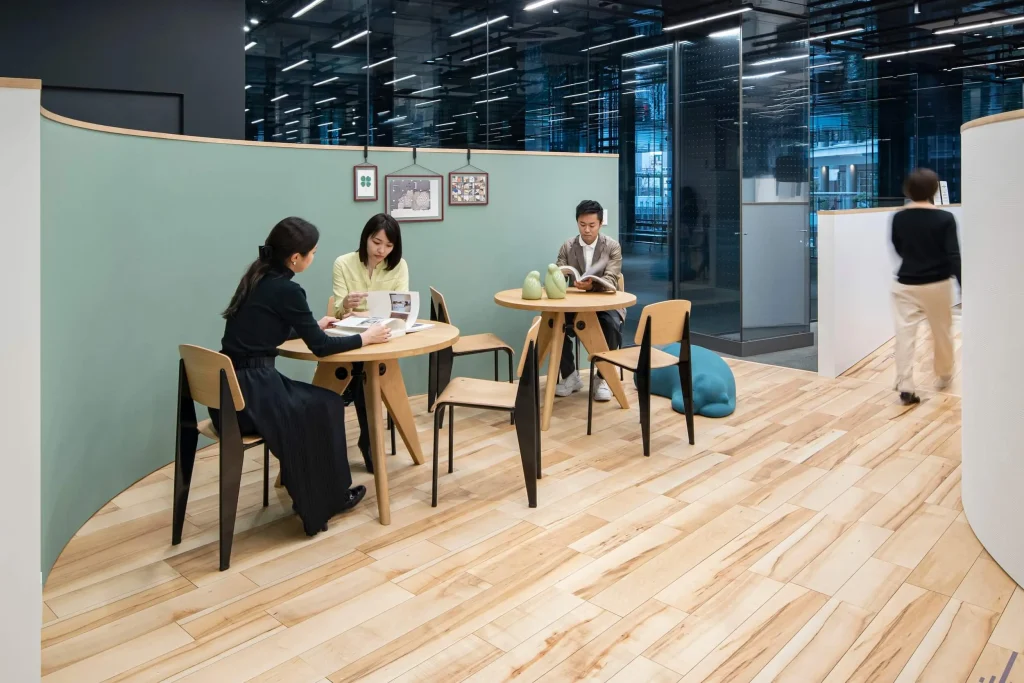
When we hear comments from the frontline such as, “This seating arrangement makes it easier to have meetings.”
, the organization’s understanding of the situation will quickly improve.
Step 4: Feedback Reflection
Improvement is not a “done deal” but a process of nurturing the space.
By gathering employee feedback and flexibly revising the space based on how it is actually used, it will be updated to better suit the way people work.
This “try it, see how it reacts, fix it” step is also a way for the general affairs department to demonstrate leadership.
These four steps are not intended to be a major renovation.
Rather, it is rooted in the idea that it is the accumulation of small improvements, rather than big plans, that creates a sense of conviction and realism within the company.
Summary: Small steps move the organization forward.
Office layout is more than just the arrangement of equipment; it is “a mechanism for designing the activities of an organization. How people sit, meet, talk, and work – all of these factors are influenced by the environment of the location. That is why it is so important for the general affairs department to make small changes and develop the office into a “better place to work.
In recent years, there has been an environment to “try small” with less risk, such as furniture subscriptions. Moving just a few lines of flow can create a conversation and certainly change the organizational climate.
You don’t have to make a major renovation right off the bat. You don’t have to have a perfect plan. Start with what is within your reach. That first step will certainly move your office reform forward.
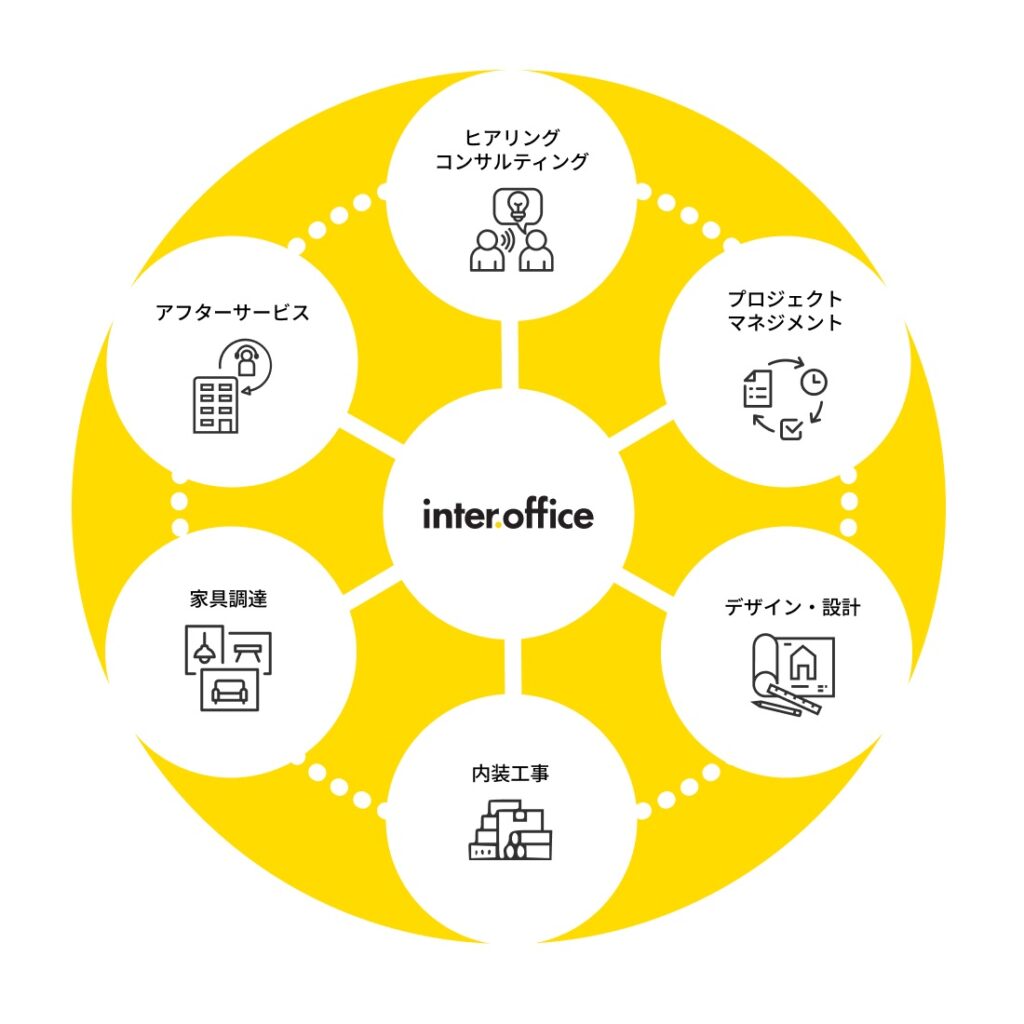
Interoffice provides one-stop support from design and construction to furniture installation and replacement. We also offer a wide range of detailed consultation services, such as “We would like to start improving just one area first,” or “We would like to verify the results with a smaller budget. We are happy to consult with you even if your plan is still in a vague stage. Please feel free to contact us, and we would be happy to work with you to shape the way you work in the future!
For inquiries or
to book a live office tour
We have five Live Offices where you can experience your ideal office and discuss the design.
Tokyo / Osaka / Fukuoka